Vaginal itching, unusual discharge, irritation, burning and unpleasant odour can occur for several reasons. Bacterial imbalance, fungal overgrowth, sexually transmitted infections and non-infectious irritation may produce similar symptoms. Correct diagnosis is therefore important before using an antibiotic or antifungal vaginal medicine.
Clindamycin and Clotrimazole Vaginal Capsules combine an antibacterial medicine with an antifungal medicine. The combination may be prescribed for certain vaginal infections in which susceptible bacteria and fungi are involved.
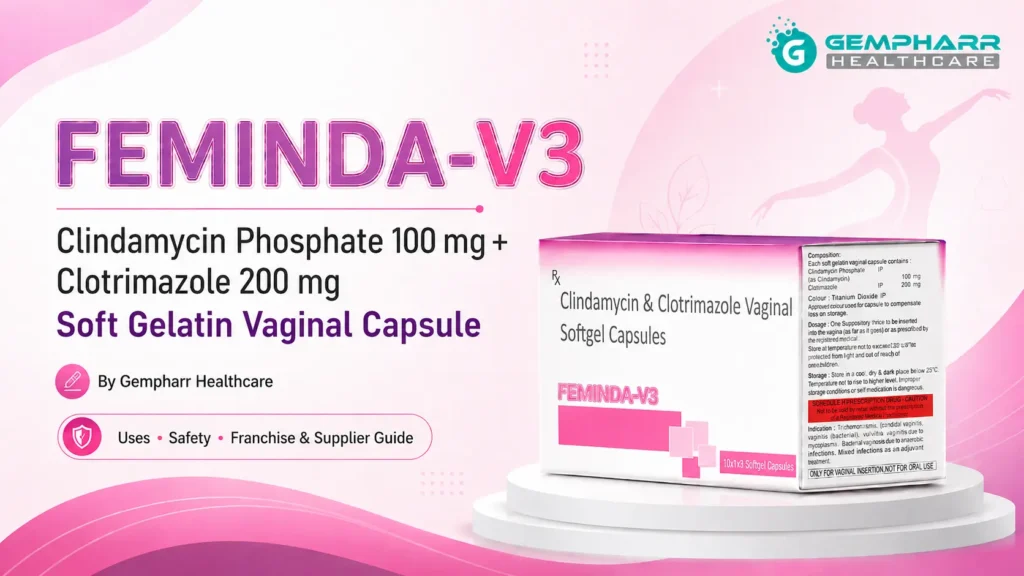
Gempharr Healthcare markets this composition under the brand name FEMINDA-V3. Each soft gelatin vaginal capsule contains Clindamycin Phosphate equivalent to Clindamycin 100 mg and Clotrimazole 200 mg. The product is intended for vaginal administration under the direction of a qualified healthcare professional. Gempharr’s official website currently lists FEMINDA-V3 among its product launches.
Medical disclaimer: This article provides general educational information. FEMINDA-V3 is a prescription product and should not be used for self-diagnosis or self-treatment. Follow the prescription, package insert and advice of your gynaecologist or healthcare provider.
What Are Clindamycin and Clotrimazole Vaginal Capsules?
Clindamycin and Clotrimazole Vaginal Capsules are soft gelatin capsules formulated for insertion into the vagina. They contain two active ingredients:
- Clindamycin: An antibacterial medicine.
- Clotrimazole: An antifungal medicine.
The combination is designed to provide local action against susceptible bacterial and fungal organisms that may be associated with vaginal infection and abnormal vaginal discharge. Clindamycin interferes with bacterial protein production, while clotrimazole damages fungal cell-membrane formation and limits fungal growth.
These capsules are sometimes described online as vaginal suppositories, pessaries or vaginal softgels. Although these terms are frequently used interchangeably in product searches, users should follow the exact dosage-form instructions printed on their prescribed product.
FEMINDA-V3 Composition and Product Overview
Brand Name : FEMINDA-V3
PACKING : SOFTGEL BLISTER(10×3)
Composition :Clindamycin Phosphate 100 mg + Clotrimazole 200mg
FEMINDA-V3 should not be swallowed unless the product label specifically states otherwise. It is formulated for vaginal administration.
Clindamycin and Clotrimazole Vaginal Capsule Uses
Clindamycin and Clotrimazole Vaginal Capsules may be prescribed for the syndromic management of vaginal discharge or for a suspected or confirmed mixed vaginal infection involving susceptible bacteria and fungi. Current medicine-information sources describe this combination as an antibacterial and antifungal treatment used for certain vaginal infections.
1. Mixed bacterial and fungal vaginal infections
A mixed vaginal infection means that more than one type of microorganism may be contributing to the condition. In selected patients, a clinician may prescribe a combination product when bacterial and fungal involvement is suspected.
The presence of two ingredients does not mean that the medicine treats every vaginal infection. Laboratory testing or a clinical examination may be required when symptoms are persistent, severe, recurrent or unclear.
2. Bacterial vaginosis involving susceptible bacteria
Clindamycin is active against certain bacteria, including anaerobic organisms associated with bacterial vaginosis. Intravaginal clindamycin is included as an option in clinical guidance for bacterial vaginosis, although the exact formulation, strength and treatment duration must be selected by a healthcare professional.
Possible symptoms of bacterial vaginosis can include:
- Thin or unusual vaginal discharge.
- A noticeable vaginal odour.
- A bit hurt.
- More symptoms post sex.
These symptoms do not mean that you have bacterial vaginosis. These symptoms can also be caused by other conditions.
3. Vulvovaginal candidiasis or vaginal yeast infection
Clotrimazole is an imidazole antifungal used in vaginal preparations for yeast infections. It stops the growth of fungi responsible for candidiasis. Vaginal clotrimazole is recognised as an intravaginal treatment for vulvovaginal candidiasis.
Possible symptoms of a vaginal yeast infection include:
- Intense itching.
- Redness or irritation.
- Burning around the vaginal area.
- Thick vaginal discharge.
- Discomfort during urination or intercourse.
Testing is particularly important when symptoms occur for the first time, keep returning or do not improve after treatment.
4. Vaginal discharge associated with susceptible organisms
The combination is widely listed for the syndromic treatment of vaginal discharge. However, vaginal discharge itself is a symptom rather than a diagnosis. Normal hormonal changes, bacterial vaginosis, candidiasis, cervicitis, sexually transmitted infections and other conditions can all change vaginal discharge.
Treatment should therefore be based on professional assessment rather than discharge colour or consistency alone.
What This Combination Does Not Automatically Treat
Clindamycin and clotrimazole should not be presented as a universal treatment for all intimate-health symptoms.
In particular, this two-drug composition should not automatically be claimed as a treatment for:
- Trichomoniasis.
- Gonorrhoea.
- Chlamydia.
- Pelvic inflammatory disease.
- Urinary tract infection.
- Genital herpes.
- Unexplained vaginal bleeding.
- Non-infectious allergic or chemical irritation.
CDC guidance states that topical clotrimazole has limited success against trichomoniasis and is not a recommended treatment. Trichomoniasis generally requires a different type of antimicrobial medicine prescribed after appropriate assessment.
And that’s an important distinction because the wrong medicine can delay diagnosis and the right treatment.
How Do Clindamycin and Clotrimazole Work?
The two ingredients act in different ways.
How clindamycin works
Clindamycin belongs to the lincosamide group of antibiotics. It attaches to bacterial ribosomes and interferes with the production of proteins that susceptible bacteria need to grow and multiply.
When administered vaginally, it provides local antibacterial action at the application site. Clindamycin does not treat fungal or viral infections.
How clotrimazole works
Clotrimazole is an azole antifungal. It interferes with ergosterol, an important part of the fungal cell membrane. This weakens the membrane and prevents susceptible fungi from growing normally.
Clotrimazole does not work against bacterial infections. Combining it with clindamycin provides both antibacterial and antifungal activity when a clinician considers that both are required.
How to Use FEMINDA-V3 Safely
Use FEMINDA-V3 only in the dose, frequency and duration prescribed by the healthcare professional. The appropriate course may vary according to the diagnosis, symptom severity, medical history and product directions.
General administration steps for vaginal softgel products may include:
- Wash and dry your hands.
- Remove one capsule from the strip only when ready to use it.
- Lie on your back, comfortably, with your knees bent.
- Gently place the capsule in the vagina. Need the kit applicator? Use it.
- Wash your hands after insertion.
- Complete the prescribed course unless your doctor advises you to stop.
Vaginal medicines are often administered at bedtime to reduce leakage, but the patient should follow the exact instructions supplied with FEMINDA-V3. Medicine-information sources similarly advise inserting clindamycin and clotrimazole vaginal products according to the label or prescriber’s directions.
Important usage precautions
- Do not swallow a vaginal capsule.
- Do not use more capsules than prescribed.
- Do not share the medicine with another person.
- Avoid tampons, douches or other intravaginal products unless your doctor approves them.
- Complete the prescribed course even if symptoms begin improving.
- Ask your doctor what to do if menstruation begins during treatment.
- Do not start another vaginal medicine without checking for compatibility.
What Should You Do After Missing a Dose?
Follow the instructions in the patient-information leaflet. In general, a missed dose may be used when remembered unless it is nearly time for the next scheduled dose.
Do not insert two capsules together to compensate for a missed dose unless a healthcare professional specifically instructs you to do so.
Possible Side Effects
Not every user experiences side effects. Local irritation is among the most frequently reported effects associated with vaginal clindamycin and clotrimazole preparations.
Possible side effects include:
- Mild vaginal burning.
- Itching.
- Irritation or redness.
- Vaginal discomfort.
- Increased or changed discharge.
- Lower abdominal discomfort.
- Pain or burning during urination.
- Headache or nausea.
Medicine-information sources list vaginal burning, irritation and itching among the common effects of the clindamycin-clotrimazole combination. Vaginal clindamycin can also cause pain, swelling, discharge or urinary discomfort in some people.
Seek urgent medical help for serious symptoms
Contact a doctor promptly if you experience:
- Severe or persistent abdominal cramps.
- Watery or bloody diarrhoea.
- Severe vaginal pain or swelling.
- Rash, hives or blistering.
- Swelling of the lips, tongue, face or throat.
- Difficulty breathing or swallowing.
- Fever, pelvic pain or worsening symptoms.
- Unexpected or heavy vaginal bleeding.
Although vaginal clindamycin is applied locally, severe antibiotic-associated diarrhoea can occur and requires medical attention.
Who Should Use Extra Caution?
Tell the prescribing doctor before using FEMINDA-V3 when you:
- Are pregnant, planning pregnancy or breastfeeding.
- Have previously reacted to clindamycin, lincomycin, clotrimazole or other azole antifungals.
- Have a history of antibiotic-associated colitis.
- Have inflammatory bowel disease.
- Have unexplained vaginal bleeding.
- Have fever, chills, pelvic pain or lower abdominal pain.
- Have sores, blisters or ulcers around the genital area.
- Frequently experience recurrent vaginal infections.
- Are taking other prescription, non-prescription or vaginal medicines.
Clotrimazole vaginal products may be used during pregnancy in some circumstances, but the safety decision for a combination containing clindamycin must be made by the treating clinician. Pregnant patients should not self-medicate based on the safety information for clotrimazole alone.
Can FEMINDA-V3 Affect Condoms or Diaphragms?
Some vaginal preparations contain bases that can weaken latex condoms or diaphragms. CDC guidance notes that clindamycin ovules may weaken latex or rubber products and advises avoiding their use for a specified period after treatment. Certain clotrimazole vaginal products may also affect latex contraception.
Patients should check the FEMINDA-V3 package insert and ask their doctor or pharmacist:
- Whether the capsule base affects latex.
- How long condoms or diaphragms should be avoided.
- Which alternative contraceptive method can be used temporarily.
This medicine does not protect against pregnancy or sexually transmitted infections.
When Should a Woman Consult a Doctor?
Medical assessment is important when:
- Symptoms are occurring for the first time.
- The patient is pregnant.
- Discharge has a strong smell or unusual colour.
- Symptoms follow unprotected sexual contact.
- There is pelvic pain, fever or bleeding.
- Symptoms return repeatedly.
- Treatment is not producing improvement.
- Symptoms become worse during use.
- Diabetes, reduced immunity or another chronic condition is present.
Persistent symptoms can indicate that the infection is resistant, the diagnosis is incorrect or a different condition is present.
FEMINDA-V3 for PCD Franchise, Distributors and Suppliers
Along with patient-focused searches, this composition attracts commercial queries from pharma professionals searching for a Clindamycin Clotrimazole Vaginal Capsule supplier, gynae-range distributorship or PCD pharma franchise opportunity.
Gempharr Healthcare offers pharmaceutical franchise, distributorship and third-party manufacturing services. Its website describes a portfolio of more than 300 products across different therapeutic categories and promotes territory-based franchise opportunities.
FEMINDA-V3 can be relevant to:
- PCD pharma franchise owners.
- Pharmaceutical distributors.
- Wholesalers of medicine.
- Gynae-range marketing companies.
- Stockists and suppliers.
- Medical representatives.
- New pharmaceutical entrepreneurs.
- Existing franchise partners expanding their women’s-health portfolio.
Availability, territory rights, pricing, minimum order quantities and commercial terms should be confirmed directly with Gempharr Healthcare.
Why Add a Gynae Product to a Pharma Portfolio?
Women’s healthcare is an established therapeutic category covering infections, menstrual health, pregnancy support, fertility, nutritional care and other gynaecological requirements.
For a distributor or franchise partner, a specialist gynae range may offer:
Focused doctor coverage
A defined product category allows representatives to create a more relevant product list for gynaecologists, women’s-health clinics and selected general practitioners.
Portfolio diversification
Adding vaginal anti-infective products can broaden a portfolio that already contains tablets, capsules, supplements and other prescription medicines.
Composition-led product searches
Doctors, distributors and retailers frequently identify pharmaceutical products by their exact salt and strength. The clear composition of Clindamycin 100 mg and Clotrimazole 200 mg makes it suitable for molecule-based product catalogues and enquiries.
Repeat institutional and trade requirements
Subject to prescription demand, stock movement and local regulations, a recognised gynae composition may be considered by wholesalers, distributors and franchise marketers serving women’s-health prescribers.
No pharmaceutical product should be promoted using guaranteed sales, guaranteed profit or misleading therapeutic claims.
What Should Distributors Check Before Taking a Franchise?
Before confirming a FEMINDA-V3 franchise or distributorship arrangement, verify the following:
- Product licence and applicable regulatory documentation.
- Batch tracking, tax invoice
- Manufacturing and marketing details.
- Composition and approved label claim.
- Product expiry and remaining shelf life.
- Storage and transport requirements.
- Minimum order quantity.
- Price list, PTR, PTS and applicable margins.
- Territory availability and monopoly conditions.
- Promotional support offered by the company.
- Replacement or expiry policy.
- Dispatch and payment terms.
The agreement should clearly explain territory, payment, supply and promotional responsibilities. Commercial viability depends on local prescription potential, competition, operating costs and compliant promotion.
Why Consider Gempharr Healthcare?
According to its company website, Gempharr Healthcare provides PCD pharma franchise, distributorship and third-party manufacturing services. The company states that it has been operating since 2008, offers an extensive pharmaceutical range and provides territory-based monopoly opportunities for eligible associates.
Potential partners can contact the company to discuss:
- FEMINDA-V3 product availability.
- Gynae-range product lists.
- Area-wise franchise availability.
- Distributor or supplier terms.
- Minimum order requirements.
- Promotional materials.
- Product pricing and commercial policies.
- Third-party manufacturing requirements, where applicable.
All certifications, licences, product approvals and commercial representations should be reviewed through current documents before signing an agreement.
Frequently Asked Questions
1. What is FEMINDA-V3 used for?
FEMINDA-V3 contains clindamycin and clotrimazole. It may be prescribed for selected vaginal infections or vaginal discharge involving susceptible bacteria and fungi. It should be used only after medical advice.
2. What is the composition of FEMINDA-V3?
Each soft gelatin vaginal capsule contains clindamycin phosphate equivalent to clindamycin 100 mg and clotrimazole 200 mg.
3. Is FEMINDA-V3 an oral capsule?
No. FEMINDA-V3 is described as a soft gelatin vaginal capsule. It is intended for vaginal use and should not be swallowed.
4. What do clindamycin and clotrimazole do?
Clindamycin inhibits protein synthesis in bacteria and clotrimazole inhibits cell membrane synthesis in fungi. They are used as antibacterial and antifungal against susceptible organisms.
5. Is there vaginitis that FEMINDA-V3 cannot treat?
No. Vaginal discharge may be caused by bacterial vaginosis, candidiasis, sexually transmitted infections, hormonal changes or non-infectious conditions. Before you can treat something, you need to diagnose it.
6. Do clindamycin and clotrimazole treat trichomoniasis?
This two-drug combination should not be assumed to treat trichomoniasis. CDC guidance does not recommend intravaginal clotrimazole as an effective treatment for trichomoniasis. Then a health care professional can prescribe another medication.
7. What are the usual side effects?
Possible effects include local burning, itching, irritation, discomfort or a temporary change in vaginal discharge. Seek medical help if these symptoms are severe or persistent.
8. Is it safe to use FEMINDA-V3 during pregnancy?
Pregnant women should use this medicine only if clearly needed and only after discussion of the risks and benefits with their doctor. Never self-medicate during pregnancy.
9. Can I have intercourse while using the vaginal capsule?
A doctor may advise avoiding vaginal intercourse during treatment. Some vaginal preparations can also weaken latex condoms or diaphragms. Check the product leaflet for the required precaution period.
10. Should I discontinue it when the symptoms improve?
Do not stop taking this medicine until your healthcare provider tells you to. Complete full course of treatment. Symptoms may get better before the infection has totally gone.
11. Is a PCD franchise available for FEMINDA-V3?
Pharma professionals can contact Gempharr Healthcare regarding the current FEMINDA-V3 franchise, distributorship or supply availability. Territory and commercial terms subject to agreement.
12. Who can become a distributor or franchise partner?
Eligibility depends on the proposed business model, required licences, territory, investment, storage arrangements and the company’s commercial policies.
Conclusion
Clindamycin Phosphate 100 mg and Clotrimazole 200 mg Vaginal Capsules combine an antibacterial and an antifungal ingredient for selected vaginal infections involving susceptible organisms. The combination may help manage bacterial and fungal components, but it is not suitable for every cause of vaginal discharge, itching or irritation.
FEMINDA-V3 is Gempharr Healthcare’s brand for this composition. Patients should use it only under professional supervision, follow the prescribed duration and seek medical advice when symptoms persist or become severe.
For franchisees, distributors and suppliers, FEMINDA-V3 represents a composition-led product within the gynae pharmaceutical segment. Interested businesses should verify territory availability, documentation, pricing, licences and commercial conditions directly with Gempharr Healthcare.