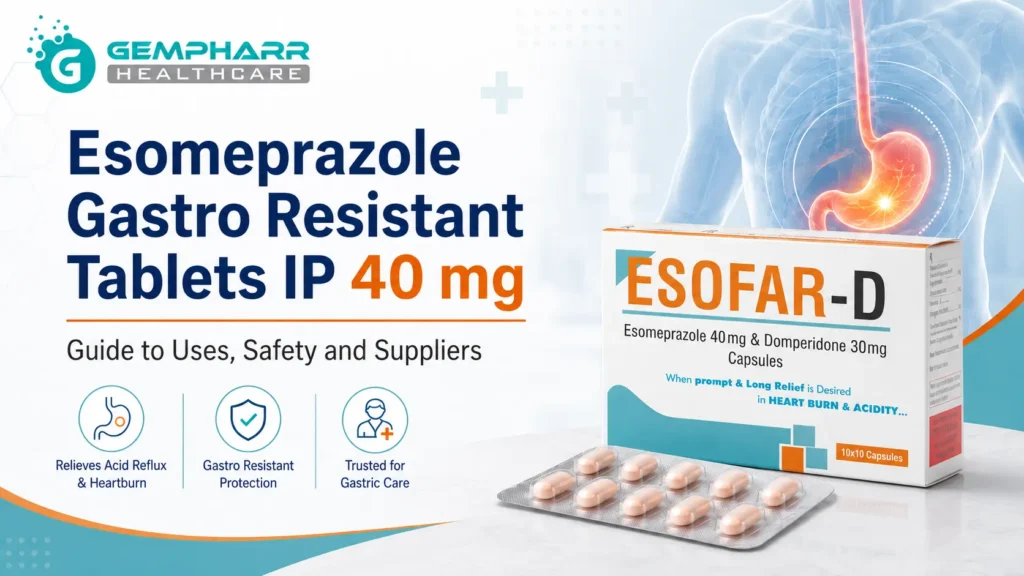
Esomeprazole Gastro Resistant Tablets IP 40 mg Medicines used to reduce the production of excess acid in the stomach. Doctors might give them to treat acid reflux, gastroesophageal reflux disease, erosive esophagitis, peptic ulcers and several other digestive conditions related to acid.
Esomeprazole is a type of drug called a proton pump inhibitor (PPI). It inhibits the pumps that produce acid in the lining of the stomach. Reducing acid may help relieve symptoms such as heartburn and enable damaged tissues in the oesophagus or stomach to heal.
The 40 mg strength should be taken only as directed by a qualified health care professional. The correct dose and length of treatment will depend on the patient’s condition, past medical history and reaction to treatment.
What are Esomeprazole Gastro Resistant Tablets IP 40 mg?
Esomeprazole Gastro Resistant Tablets IP 40 mg contains active pharmaceutical ingredient Esomeprazole. Product labels usually specify the salt form used and the amount equivalent to 40 mg of esomeprazole.
Gastro-resistant means that the tablet has a special coating that provides protection. The coating makes sure the medicine doesn’t dissolve too fast in the acid in your stomach. This means the active ingredient gets to the gut where it is released and absorbed properly.
Because the protective coating is important, gastro-resistant tablets should generally be swallowed whole. They should not be crushed or chewed unless a doctor or the product information specifically provides an alternative method.
The abbreviation IP refers to the Indian Pharmacopoeia. It is India’s official book of drug-quality standards, published by the Indian Pharmacopoeia Commission on behalf of the Ministry of Health and Family Welfare. An IP-labelled medicine is expected to comply with the applicable pharmacopoeial specifications for identity, strength, purity and quality.
How Does Esomeprazole 40 mg Work?
In the stomach, acid is usually produced to break down food. However, excessive acid or the backward movement of acid into the oesophagus can cause burning, irritation and tissue damage.
Esomeprazole blocks an enzyme system known as the gastric proton pump. This system is responsible for the final stage of stomach-acid production. Esomeprazole works by blocking the amount of acid released into your stomach.
The medicine is not usually intended to provide instant relief like an antacid. Its full acid-suppressing effect may take time to develop. So, patients should take it as prescribed and not take extra tablets for quick relief of symptoms.
Uses of Esomeprazole Gastro Resistant Tablets IP 40mg
Esomeprazole Gastro Resistant Tablets IP 40 mg is used for the treatment of various acid related disorders.
1. The condition known as gastroesophageal reflux disease
When the contents of the stomach flow back into the oesophagus on a regular basis, this condition is known as gastroesophageal reflux disease, or GERD. This can lead to symptoms such as heartburn, sour taste in the mouth, pain after eating and inflammation of the food pipe.
Esomeprazole reduces reflux symptoms and acid exposure.
2. Erosive Oesophagitis
Persistent acid reflux can inflame and damage the lining of the oesophagus. This condition is called erosive oesophagitis.
Esomeprazole 40 mg may be prescribed for short-term healing of erosive oesophagitis. Once healing occurs, a healthcare professional may review the treatment and determine whether a different maintenance dose is needed.
3. Peptic and Duodenal Ulcers
Esomeprazole may form part of the treatment plan for ulcers affecting the stomach or the first part of the small intestine.
When an ulcer is associated with Helicobacter pylori, esomeprazole may be prescribed together with suitable antibiotics. Patients should not start antibiotic combinations without medical advice because the correct medicines, doses and treatment duration must be selected professionally.
4. Prevention of NSAID-Associated Ulcers
Regular use of non-steroidal anti-inflammatory drugs, or NSAIDs, can increase the risk of stomach irritation and ulcers in some patients.
A doctor may prescribe a proton pump inhibitor to reduce the risk of gastric ulcers in suitable patients who need ongoing NSAID treatment.
5. Conditions of Excess Acid
Output Esomeprazole may also be used to treat rare conditions in which your stomach makes too much acid, such as Zollinger-Ellison syndrome. These need specialist monitoring, diagnosis and individualised dosing.
How Should Esomeprazole 40 mg Be Taken?
Patients should follow the package instructions for medication.
Esomeprazole is commonly taken once daily, although some conditions may require a different schedule. Treatment duration also varies. A higher strength should not be continued simply because symptoms return after eating spicy food or missing a dose.
General administration precautions include:
- Swallow the gastro-resistant tablet whole with water.
- Do not crush or chew the tablet.
- Take it at approximately the same time each day.
- Do not double the next dose after a missed dose.
- Do not stop prolonged treatment suddenly without consulting the prescriber.
- Ask a doctor or pharmacist for guidance if swallowing the tablet is difficult.
Food instructions can vary between individual products and treatment plans. Patients should therefore follow the prescribing advice and the leaflet supplied with their specific medicine.
Common Side Effects
Not every patient experiences side effects. Commonly reported effects can include:
- Headache
- Nausea or vomiting
- Diarrhoea
- Constipation
- Stomach discomfort
- Excess gas
- Dizziness in some patients
These effects are often mild, but persistent or troublesome symptoms should be discussed with a healthcare professional.
Urgent medical attention may be required for symptoms such as facial swelling, difficulty breathing, severe skin reactions, persistent watery diarrhoea, unexplained reduction in urination, black stools, vomiting blood or severe abdominal pain.
Long-Term Safety Considerations
Proton pump inhibitors can be highly useful when prescribed appropriately. However, prolonged or unnecessary treatment should be reviewed periodically.
Long-term acid suppression may be associated with low magnesium levels, reduced vitamin B12 absorption and an increased risk of certain bone fractures in susceptible patients. A doctor may recommend clinical review or laboratory monitoring for people receiving extended treatment, particularly when other risk factors are present.
Patients should tell their doctor if they have liver disease, osteoporosis, low magnesium or calcium levels, vitamin B12 deficiency, autoimmune disease or a history of medicine allergies.
Important Medicine Interactions
Esomeprazole can affect the absorption or action of certain medicines. Patients should provide their doctor or pharmacist with a complete list of prescription medicines, non-prescription products and supplements.
Particular care may be needed with clopidogrel. Esomeprazole inhibits an enzyme involved in converting clopidogrel into its active form, which may reduce its antiplatelet effect. The prescriber may need to consider another acid-suppressing medicine or antiplatelet strategy.
Interactions may also be relevant with selected HIV medicines, antifungal medicines, high-dose methotrexate, digoxin and medicines affected by changes in stomach acidity. Treatment should not be changed without professional advice.
Who Should Consult a Doctor Before Taking It?
Medical advice is especially important for people who:
- Are pregnant, breastfeeding or planning pregnancy
- Have severe or persistent heartburn
- Experience difficulty or pain while swallowing
- Have unexplained weight loss
- Have repeated vomiting
- Notice blood in vomit or black stools
- Have liver disease
- Take clopidogrel or multiple long-term medicines
- Have symptoms that continue despite treatment
Chest pain, sweating, breathlessness or discomfort spreading to the arm, shoulder, neck or jaw should not automatically be assumed to be acidity. These symptoms require prompt medical evaluation.
Supplier Guide for Esomeprazole Gastro Resistant Tablets IP 40 mg
Pharmaceutical distributors, franchise partners, hospitals and procurement teams should assess more than the product price while selecting a supplier.
A reliable supplier should provide:
- A valid drug licence and appropriate regulatory documentation.
- Clearly declared composition and pharmacopoeial standard.
- Batch number, manufacturing date and expiry date.
- Manufacturer details on every saleable pack.
- Suitable storage and transportation controls.
- Batch-specific certificate of analysis when commercially applicable.
- Blister packaging should be secure and print legible.
- Invoices you can track. Stocks available.
Buyers should consider shelf life, minimum order quantity, packaging configuration, replacement policy and delivery conditions when buying in bulk.
Do not buy products with broken blisters, unclear batch information, spelling mistakes, changed labels or suspiciously low prices from an unverified source. Quality, traceability and regulatory compliance must always be a focus of pharmaceutical procurement.
Frequently Asked Questions
Is esomeprazole 40 mg used for gas?
It primarily reduces stomach acid. It is not a general treatment for every cause of gas or bloating.
Does esomeprazole give instant acidity relief?
It is not an instant-relief antacid. Its full effect may take time to develop.
Can I take esomeprazole 40 mg every day?
Daily use should be based on a doctor’s recommendation, especially for the 40 mg strength or prolonged treatment.
Should the tablet be chewed?
No. A gastro-resistant tablet should normally be swallowed whole because chewing can damage its protective coating.
Is esomeprazole an antibiotic?
No. It is a proton pump inhibitor. It may be combined with antibiotics when treating an H. pylori-associated ulcer.
Can it be taken with clopidogrel?
The combination can be clinically important because esomeprazole may reduce clopidogrel activation. The prescriber should review the treatment.
Is Esomeprazole Gastro Resistant Tablets IP 40 mg a prescription medicine?
The 40 mg strength should be supplied and used according to applicable prescription and regulatory requirements.
What should distributors check before purchasing?
They should verify licences, manufacturer details, batch traceability, packaging quality, shelf life, storage conditions and supporting quality documents.
Conclusion
Esomeprazole Gastro Resistant Tablets IP 40 mg help reduce stomach-acid production and may be prescribed for GERD, erosive oesophagitis, peptic ulcers, NSAID-associated ulcer risk and other acid-related conditions.
Although the medicine is widely used, the 40 mg strength should not be treated as a routine solution for every episode of acidity. Correct diagnosis, appropriate treatment duration, interaction checks and periodic review are essential for safe use.
For pharmaceutical buyers, selecting an authorised and transparent supplier is equally important. Product quality, documentation, packaging, and batch traceability must not be compromised by price.
Medical disclaimer: This information is for general educational purposes only and is not intended to be medical advice, diagnosis, prescribing advice or treatment from a qualified medical professional.